Who Gets to Know? The Grand Bargain's Missing Commitment
This piece examines the production and control of knowledge in the humanitarian system as a less discussed dimension. The Grand Bargain's commitments on transparency and on joint needs assessment asked organisations to publish and share their data; none gave local actors or affected people authority over the evidence itself: who produces it, who holds it and who can contest it. That authority is the missing commitment of the title.

Deleting self-reliance: what the SOHS 2026 finding looks like in a donor's own funding texts
Aid recipients asked for the chance to need aid less, and SOHS 2026 records that funding cuts went the other way. DG ECHO's Palestine decisions show how: the words nexus, resilience and self-reliance disappear from the text first, and the budgets follow.
Aid Worker Security in 2025
World Humanitarian Day marks the 23rd anniversary of the Canal Hotel bombing in Baghdad. The commemoration is built on a count of the dead, injured and kidnapped. That count now misses the fastest-growing threat to humanitarian staff, and the weapon most responsible for reshaping it has no place in the taxonomy at all.
Protection Funding 2021–2026: The Cuts Reached the Evidence
Protection is the part of humanitarian response that is hardest to defend in a shrinking budget and hardest to rebuild once cut. It does not deliver a tonnage figure. Its outputs are presence, continuity, case files and analysis, and those are the first line items to go when donors narrow their funding around visibly life-saving delivery.
Global Humanitarian Assistance 2026: The Humanitarian System's Great Contraction
ALNAP's Global Humanitarian Assistance Report 2026 documents the worst year in the humanitarian system's recent history. Total international humanitarian assistance fell to US $33.3 billion in 2025, down 20% in one year and 30% from the 2022 peak. The system now runs on 2017-level resources while 300 million people are estimated to be in need
DRC: 2026 Ebola Outbreak
On 15 May 2026, authorities in the Democratic Republic of Congo declared an Ebola outbreak after cases were confirmed in Ituri and North Kivu, with further cases later confirmed in South Kivu.
The Future of Syria: Economic Recovery and EU–Syria Relations
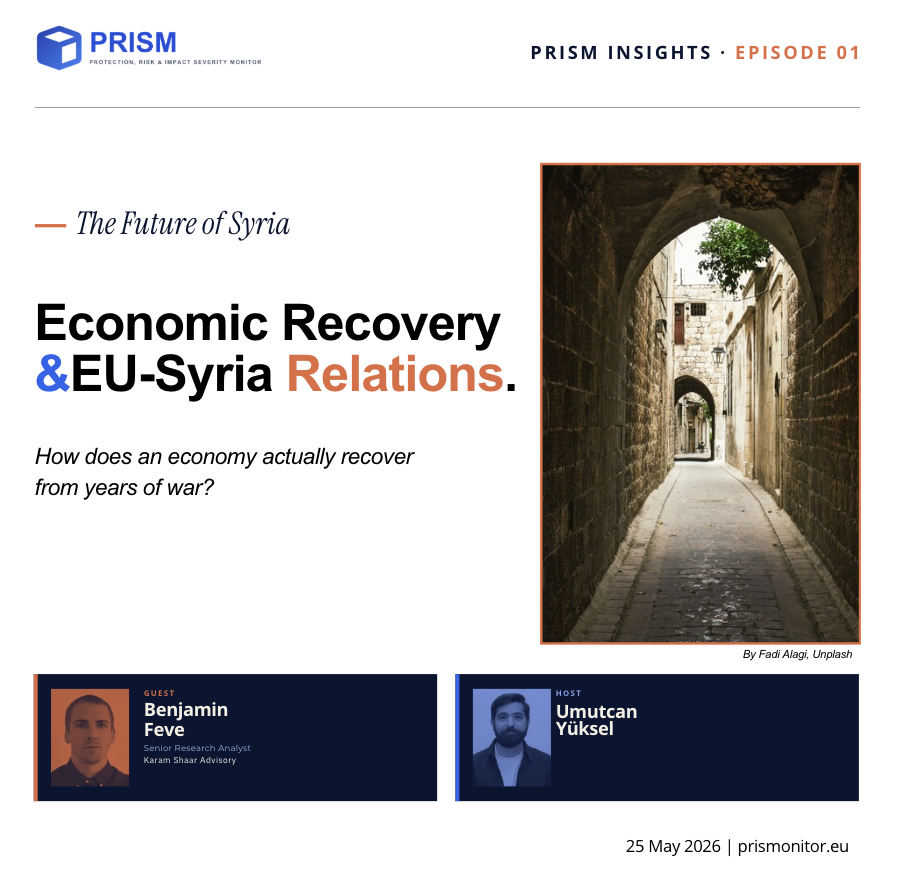
15 months after Assad's fall, what does Syria's economy actually look like? Senior Research Analyst Benjamin Feve (Karam Shaar Advisory) joins PRISM's Umutcan Yüksel to unpack recovery, EU sanctions relief, the energy crunch, and the investment-vs-aid debate shaping Syria's future.

The Great Contraction: OECD DAC Preliminary ODA Data 2025
Official Development Assistance from DAC members fell 23.1% in real terms in 2025 to $174.3 billion — the largest annual contraction in the 66-year history of ODA reporting. The United States drove three-quarters of the decline with a record 56.9% cut, the single largest reduction by any provider in any year. Germany became the world's largest donor for the first time, surpassing the US by just $135 million — a crown earned by default as its own ODA fell 17.4%. Humanitarian aid collapsed by 35.8% to $15.5 billion, while Ukraine received more ODA ($44.9B including EU Institutions) than all 44 least developed countries combined ($28.1B). Only 4 of 33 DAC members now meet the 0.7% GNI target. OECD projects a further 5.8% decline in 2026. Non-DAC providers bucked the trend, growing 4.5% to $13.3 billion, led by UAE (+55.5%) and Qatar (+23.4%).

Syria's Shelter & Displacement Landscape: A Cross-Sectoral Analysis
A comprehensive analysis of Syria's shelter and displacement landscape following the December 2024 political transition. With 5.96 million people still internally displaced, 1.2 million cross-border returns, and $216 billion in estimated reconstruction costs, this deep dive examines fourteen interconnected dimensions — from IDP trajectory and camp closures to real estate markets, industrial recovery, and investment governance — through the Humanitarian-Development-Peace (HDP) nexus lens. Includes live IOM DTM data, EMT Round 5 cross-border monitoring (196,654 individuals at points of entry), interactive maps, and ten policy recommendations for the international community.

The State of Humanitarian Data
Humanitarian data availability fell to 68% across active crisis operations in 2025 — down from 74% — as unprecedented funding cuts eliminated data staff, disbanded enumerator networks, and shrank geographic coverage.

Area-Based Child Protection Risk Analysis: Ukraine
Armed conflict, mass displacement, and deepening poverty have created a child protection crisis in Ukraine that differs sharply from one oblast to the next. This analysis uses 12 open-source 2024 publications and datasets — household surveys, displacement tracking, needs assessments, protection monitoring, and coordination records — to build an oblast-level composite risk profile.

From Iran to Gaza: Mapping the Humanitarian Shockwave of the US-Israeli War on Iran
Since the launch of the US-Israeli war on Iran, 4,148,100 people have been internally displaced across the region. In Iran, 1,348 civilians have been killed and over 17,000 injured since the start of the attacks carried out by Israel and the US.