Deep Dives & Analysis

In-depth research, policy notes, situation updates, and datasets from PRISM

The Great Contraction: OECD DAC Preliminary ODA Data 2025
Deep Dive

The Great Contraction: OECD DAC Preliminary ODA Data 2025

Official Development Assistance from DAC members fell 23.1% in real terms in 2025 to $174.3 billion — the largest annual contraction in the 66-year history of ODA reporting. The United States drove three-quarters of the decline with a record 56.9% cut, the single largest reduction by any provider in any year. Germany became the world's largest donor for the first time, surpassing the US by just $135 million — a crown earned by default as its own ODA fell 17.4%. Humanitarian aid collapsed by 35.8% to $15.5 billion, while Ukraine received more ODA ($44.9B including EU Institutions) than all 44 least developed countries combined ($28.1B). Only 4 of 33 DAC members now meet the 0.7% GNI target. OECD projects a further 5.8% decline in 2026. Non-DAC providers bucked the trend, growing 4.5% to $13.3 billion, led by UAE (+55.5%) and Qatar (+23.4%).

2026-04-13
92 views
Middle East Situation Update #3
Situation Update
Iran Lebanon Syria Afghanistan  Pakistan Iraq Türkiye

Middle East Situation Update #3

The regional crisis triggered by the 28 February 2026 US-Israeli military offensive against Iran has displaced an estimated 4.25 million people internally across Iran (3.2M) and Lebanon (1.05M+), while generating over 574,000 cross-border movements across nine countries. A two-week ceasefire was announced on 9 April, but the 8 April strikes in Lebanon — over 100 strikes within 10 minutes, killing 200+ — underscore continued volatility. IOM DTM Round 5 tracks 359,532 crossings from Lebanon to Syria, 141,538 from Iran to Afghanistan, and 88,600 to Turkiye. The Strait of Hormuz closure has driven oil prices up ~50%, with WFP warning 45 million additional people could face acute food insecurity globally. Flash appeals totalling $388M are critically underfunded: Iran at 8%, Lebanon at 14%.

2026-04-13
71 views
Syria's Shelter & Displacement Landscape: A Cross-Sectoral Analysis
Deep Dive
Syria

Syria's Shelter & Displacement Landscape: A Cross-Sectoral Analysis

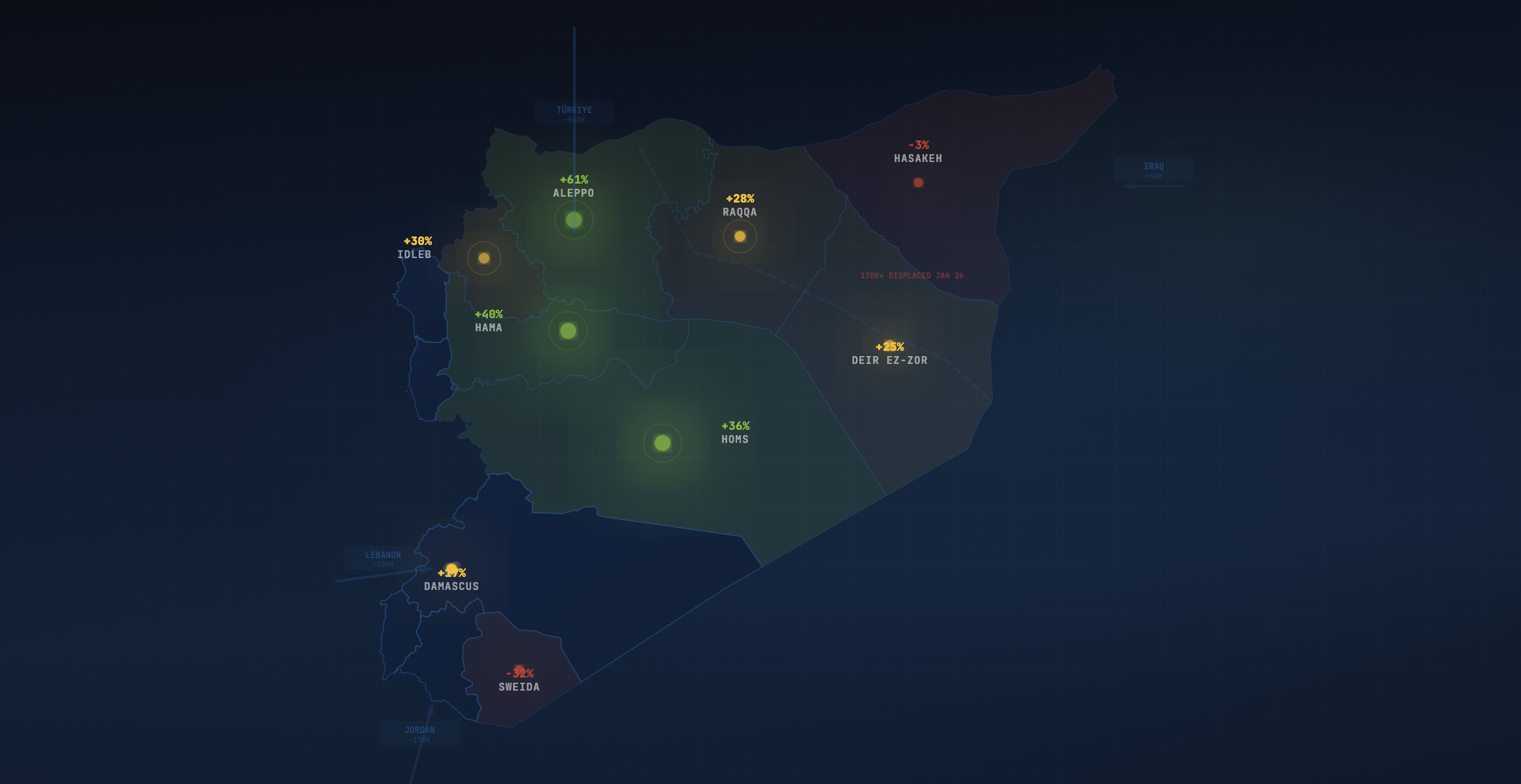
A comprehensive analysis of Syria's shelter and displacement landscape following the December 2024 political transition. With 5.96 million people still internally displaced, 1.2 million cross-border returns, and $216 billion in estimated reconstruction costs, this deep dive examines fourteen interconnected dimensions — from IDP trajectory and camp closures to real estate markets, industrial recovery, and investment governance — through the Humanitarian-Development-Peace (HDP) nexus lens. Includes live IOM DTM data, EMT Round 5 cross-border monitoring (196,654 individuals at points of entry), interactive maps, and ten policy recommendations for the international community.

2026-04-13
42 views
The State of Humanitarian Data
Dataset

The State of Humanitarian Data

Humanitarian data availability fell to 68% across active crisis operations in 2025 — down from 74% — as unprecedented funding cuts eliminated data staff, disbanded enumerator networks, and shrank geographic coverage.

2026-03-20
186 views
Area-Based Child Protection Risk Analysis: Ukraine
Deep Dive
Ukraine

Area-Based Child Protection Risk Analysis: Ukraine

Armed conflict, mass displacement, and deepening poverty have created a child protection crisis in Ukraine that differs sharply from one oblast to the next. This analysis uses 12 open-source 2024 publications and datasets — household surveys, displacement tracking, needs assessments, protection monitoring, and coordination records — to build an oblast-level composite risk profile.

2026-03-19
102 views
From Iran to Gaza: Mapping the Humanitarian Shockwave of the US-Israeli War on Iran
Situation Update
Iran Palestine Lebanon

From Iran to Gaza: Mapping the Humanitarian Shockwave of the US-Israeli War on Iran

Since the launch of the US-Israeli war on Iran, 4,148,100 people have been internally displaced across the region. In Iran, 1,348 civilians have been killed and over 17,000 injured since the start of the attacks carried out by Israel and the US.

2026-03-15
426 views
Middle East Situation Update #2
Situation Update
Iran

Middle East Situation Update #2

Operation Epic Fury, launched jointly by the United States and Israel on 28 February 2026, marks the largest military escalation in the Middle East since 2003. Over 2,000 strikes have been conducted against targets in Iran, while Iranian retaliatory missile and drone salvos have struck seven neighbouring states. By 6 March, the UN declared the crisis a “major humanitarian emergency” affecting regions hosting nearly 25 million refugees. Civilian casualties, mass displacement, and humanitarian supply-chain disruptions are escalating daily across a theatre spanning from Beirut to the Strait of Hormuz.

2026-03-09
337 views
Lebanon reports over 83,000 displaced as hostilies with Israel intensify
Situation Update
Lebanon

Lebanon reports over 83,000 displaced as hostilies with Israel intensify

A massive Israeli military escalation struck Lebanon beginning 2 March 2026, following a large-scale projectile barrage from Lebanon toward northern Israel. Strikes targeted command centres in Beirut, the Bekaa Valley, and southern Lebanon, triggering mass civilian evacuations. By 4 March, Israel had launched a ground invasion of southern Lebanon and issued forced evacuation orders for the entire region south of the Litani River. At least 83,000 people have been displaced, with over 12,000 families sheltering in 300+ collective sites — dozens already at full capacity. At least 72 people have been killed (including 7 children) and 437 wounded.

2026-03-05
162 views
Middle East Situation Update #1
Situation Update
Iran

Middle East Situation Update #1

This analysis traces the full arc from the December protests through to 28 February 2026, examining Iran’s land, air, rail and maritime crossing infrastructure in its current conflict-disrupted state. It provides a systematic assessment of the migration management frameworks and border policies of each of Iran’s seven neighbouring states — a critical factor for determining how many people from Iran may be able to seek safety, through which corridors, and under what protection frameworks.

2026-02-28
213 views
Ukraine Energy Infrastructure: Winterization Response & Facility Status
Deep Dive
Ukraine

Ukraine Energy Infrastructure: Winterization Response & Facility Status

An integrated analysis of systematic attacks on critical civilian energy infrastructure, facility-level operational status, and the humanitarian winter response for the 2025–2026 heating season — the most severe since the full-scale invasion of February 2022.

2026-02-28
116 views
Occupied Palestinian Territory Situation Update
Situation Update
Palestine

Occupied Palestinian Territory Situation Update

This situation update consolidates data from OHCHR, OCHA FTS, the INFORM Risk Index, ACLED, Eurostat, the Gaza Protection Monitoring System, and West Bank protection analysis to provide a comprehensive picture of the crisis as of February 2026. The findings are uniformly severe: 13 out of 15 protection risk categories are at maximum severity, the conflict probability score is 10 out of 10, and the territory now has the highest number of amputee children per capita in the world.

2026-02-25
249 views
Energy Sector and Population Movement Nexus in Syria
Deep Dive
Syria

Energy Sector and Population Movement Nexus in Syria

This deep dive cross-references energy infrastructure data—power plant output, gas supply, oil production, satellite nighttime lights—with UNHCR displacement and return figures to surface a structural pattern: people return to where the lights are on.

2026-02-15
307 views